Joseph Issa-Mentorship Spurs Growth of Small Business in 2014.

Dam Good Brownies, a little known Jamaican brand of chocolate-based brownies owned by 26-year-old Dominic McDowell, is experiencing significant growth in 2014, which he attributes in an interview, to the mentorship of businessman and philanthropist, Joe Issa, while attending a 12-week training programme at the Branson Centre of Entrepreneurship in Montego Bay, St. James.


Dominic McDowell.jpg
Dominic McDowell


“This year, I have achieved significant growth in my small business thanks to the training at the Branson Centre and the mentorship of Joe Issa. I started an awareness campaign, and this has paid off with increased production and sales,” said McDowell in a recent interview.

McDowell says he started operating from home three years ago but went full scale in January 2013. He says, “At first it was only me and afterwards I employed two workers and was producing 500 units per week. However, after I started the training and began interacting with my mentor Joe Issa, I realised that more could be achieved. He encouraged me to expand, and very quickly I moved to 600 units per week.”

“Upon further consultation with my mentor I expanded further, to 1,000 units per week and within two weeks I will be producing 1,600 units per week,” McDowell informs.

Growing his business on a model that involves only manufacturing and distribution, Dominic says he does not want a front store, even when he moves to a new and more prominent location within two years. This business model, he states, has been supported by the training.

“My mentor was very supportive of my business model, which is to concentrate on production and distribution only. I do not want to get involved in setting up a sales outlet in front of my factory, and he supported that. This means that my new factory does not have to be located on expensive, main street sites”, he argues.

Joey 5

Stating that he has benefited immensely from his association with the centre and its mentorship programme, McDowell recalls that lucky day in December 2012 when he came in contact with the centre for the first time.

“I had a booth at the Jamaica Young Professionals’ Market Place, and a vendor who was a past Branson Centre trainee invited me to view the centre’s booth there and register to join its programme.

“I have absolutely no regrets since doing so; the training was great, we shared our experiences and formed strategic alliances. Joe Issa was extremely helpful. He enabled me to get access to human resources; I could call him and members of his team for assistance. The experience has been good for me; it has helped solidify my business model and enabled me to expand distribution,” says McDowell.

He says Joe Issa encouraged him to make several strategic moves, which have enabled the business to expand, including the establishment of a website, http://www.facebook.com/DAMGoodEnterprises to push the brand, which he describes as a cross between a cake and a cookie.

McDowell says he has also employed three Brand Ambassadors based at the University of the West Indies and University of Technology (UTech) to promote the product. He says, “They make sales and create brand awareness, and this has led to a significant increase in sales.”

The Dam Good Brownies brand, in which ‘DAM’ represent McDowell’s initials has already developed its logo and other promotional material, which are distributed by the Brand Ambassadors at the universities and other promotional events.

McDowell says getting to where he is at today has not been easy. “The journey has been overwhelming, regarding the varied learning experiences. I had to make many sacrifices to benefit the business, and I know that lots more sacrifices will have to be made to get to where I want,” he says, stating that the experience so far has been rewarding.

“I got lots of encouragements and some criticisms, in order to improve the business,” he says, while encouraging new entrants into business to register with the Centre and seek the mentorship of Joe Issa, who, along with Ben Carson’s ‘Think Big’has taught me to avoid the fear of failure, be strong, believe in what I want and go for it with confidence.”

The Branson Centre of Entrepreneurship – Caribbean was opened in Montego Bay by Sir Richard Branson in September 2011 to support the development of small and growing businesses to create jobs and contribute to the economy in the Caribbean region, says its website,http://www.bransoncentre.org/caribbean/home.html.

Since the launch, 60 entrepreneurs have accessed the programme, representing a wide range of industries, including agriculture, the creative arts, ICT, fashion and accessories, environmental protection and tourism products.
Famously known as founder and chairman of the Virgin Group of some 400 companies, Sir Richards’ successful business strategies have been emulated by like-minded persons throughout the world, including his friend Joe Issa who, within 15 years has grown his Cool brand from one to a number of successful companies, according to the Cool Group website, http://www.coolcorp.com.

Joey Issa, Obama Pay Touching Tribute to Music Icon Prince

Like Joe Issa, it is not clear whether President Obama can sing or play any instruments, but that did not stop both men paying touching tribute to dead music icon Prince, who has been described as innovative and philanthropic, and a healthy-lifestyle enthusiast.

Joey 5

“I was at university when Purple Rain hit the airwaves, and everyone loved the song, along with many of his other hits. I think the music fraternity has lost an icon, a real genius who thrilled audiences throughout the world,” said Issa, as he reacts to news of the death of the music superstar.

Continuing, Issa, who is a great lover of many music genres, said Prince was a very innovative and creative singer and songwriter and was always pushing the envelope to entertain his fans around the world.

“See how, with no acting experience, he engineered his way into getting a deal to star in a major motion picture about his life, with the Purple Rain album as the soundtrack, and what an album that was,” says Issa, who is a business innovator with several product brands under his belt.

The 1984 hit film won Prince an Academy Award for Best Original Song Score and grossed more than $80 million in the US. Songs from the film hit pop charts in the US and Europe.

prince 1

That year, Prince simultaneously had the No. 1 album, single, and film in the US; it was the first time a singer had achieved this feat, according to Wikipedia, which also informed that the Purple Rain album is ranked 72nd in Rolling Stones 500 Greatest Albums of All Time and is included on the list of Time magazine’s All-Time 100 Albums.

Issa’s wide choice in music, which include pop, R&B, funk, rock and jazz is said to be partly influenced by his university education in the United Kingdom and the United States, where “the intensely private musician” was found dead at his home in suburban Minneapolis, Minnesota on Thursday at the age of 57, “shocking millions of fans around the world and prompting glowing tributes by fellow musicians,” a Reuters report said.

pres obana

Like Issa, Prince was a philanthropist and a very private and religious person, who once said, “A strong spirit transcends rules,” in respect of which, President Obama, who once hired him to perform at a private party, wrote: “Nobody’s spirit was stronger, bolder or more creative…Our thoughts and prayers are with his family, his band and all who loved him.”


Joey Issa Likes What Makes Sense: Healthy Seas, Happy People

A successful entrepreneur, Joe Issa, who is believed to know more than most what makes sense in business and philanthropy, now adds the environment on his list, as he supports the slogan: “Healthy Seas…Happy People. Makes Sense!

Commenting on an article of the same title which shames humans for littering the sea with garbage and destroying critical fish habitats, Issa says “it makes sense to keep the sea healthy so that we can continue to exploit its resources much to our pleasure and happiness.”

That the resources of the sea are depleting rapidly by human actions, Issa remarked, “You cannot argue against that; the evidence is glaring all along our coastlines and harbour, which serve as repositories for garbage such as plastic bottles and Styrofoam washed away by rivers and gullies whenever it rains.”

In addition to garbage, humans are also said to be continually polluting the sea with untreated or partially treated sewage, industrial effluent, ship pollution, or the runoff of chemicals used in agriculture. As much as 40 percent of the world’s oceans are believed to be profoundly affected by human activities including pollution, depleted fisheries, and loss of coastal habitats.

clean seas 1

“It’s common sense that if we do not restore the health of the sea by proper disposal of garbage and cleaning and replenishing our coral reefs and mangroves, sooner or later we won’t have a fish to put on the table and a beach to go to, and we won’t be too happy about that,” says Issa.

In agreeing with the article that “the beach is a constant lure for Jamaicans in all walks of life…an escape, the epitome of relaxation and quite simply, the sea makes us happy”, Issa warns, however, that “soon, this will no longer be the case when the sea becomes too polluted to swim in and harbour marine life.”

Noting that the sea has been a source of livelihood for billions of people throughout the world, Issa argues that “if we continue to take from the sea without giving back to it, eventually, it will be unable to sustain life as we know it.”

According to the United Nations, it is the oceans – their temperature, chemistry, currents and life – that drive the global systems that make it possible to live on earth, stating that “our rainwater, drinking water, weather, climate, coastlines, much of our food, and even the oxygen in the air we breathe, are all ultimately provided and regulated by the sea.”

While lamenting the senseless human actions that are causing the earth’s temperature and sea level to rise, Issa finds some comfort in the oceans’ ability to counteract them, contending that “it is a good thing that the oceans can absorb some 30 percent of the carbon dioxide which we produced. Otherwise, the impacts of global warming would have been more pronounced today.”

In acknowledging the might of the world’s oceans, Issa invokes UN data which show that they cover three-quarters of the Earth’s surface, contain 97 percent of the Earth’s water, and represent 99 percent of the living space on the planet by volume.

It said over three billion people depended on marine and coastal biodiversity for their livelihoods and estimated the global market value of marine and coastal resources and industries at $3 trillion per year or about five percent of global gross domestic product (GDP).

Mindful that the oceans and seas have been vital conduits for trade and transportation throughout history, Issa supports the suggestion that “careful management of this essential global resource is a key feature of a sustainable future.”


Joey Issa Amused at Sir Richard’s Photo bomb of Employee Napping on the Job

A colleague of Sir Richard Branson Joe Issa, whose Cool Group business model has been likened to Sir Richard’s Virgin Group, was humoured by a photo of Branson posing with an employee sleeping on the job.

joey in kitchen

“This is funny! I was so amused when I saw the photo; it’s a great sense of humour displayed by Sir Richard, and the poor employee didn’t have a clue of what was going on as Sir Richard took pleasure in photo-bombing his sleep, much to the amusement of the air hostess in the background,” Issa recalls.

Issa, who has entertained Sir Richard, among a long list of celebrities, says “the best part of the joke is when Sir Richard woke him up, and when he looked and saw him, thought he was dreaming and went right back to sleep. I would like to see a video of that part,” says Issa, who is a mentor at the Branson Centre for Entrepreneurship – the Caribbean based in Montego Bay.

According to a Yahoo article, “It is never a good time to be caught napping by your boss – especially when that boss is the head of the entire company, which is just what happened to an unfortunate Virgin Australia worker who decided to take a nap on the job.

                      Richard Branson photobombs his employee sleeping on the job.

However, Branson is said to have seen the funny side and rather than shouting decided instead to grab a photo with him, much to the amusement of Flight attendants in the background.

“I popped into the office and the airport to say hello and check in to see what the teams are up to. This guy was not up to much at all. I caught him sleeping on the job! Wow, did he get a shock when I woke him up? He must have thought he was dreaming because he went straight back to sleep,” Branson is said to have later written on the company blog, adding, “To be fair, he was on standby, getting some much-needed rest. At least he was not asleep on the plane – that might have been less amusing.”

Joseph Issa – Former Chamber President Expresses Concern Over Rising Unemployment In The Caribbean.

Former President of the St. Ann Chamber of Commerce Joe Issa has expressed concern over reports pointing to an increase in unemployment in the Caribbean.

Issa, who has often spoken on issues affecting the Caribbean, including climate change, said: “this is bad news; as a region we should be growing our economies to increase employment for our young people and alleviate poverty, not making things worse for them.”

Issa was reacting to a new UN report which says unemployment continues to rise in the Caribbean.

According to a CMC report out of Santiago, Chile, carried by the Jamaica Observer, “two United Nations agencies say that urban unemployment will keep rising in Latin America and the Caribbean and could reach 9.4 percent in 2017.”

In releasing the newest edition of their joint publication, “Employment Situation in Latin America and the Caribbean,” the Economic Commission for Latin America and the Caribbean (ECLAC) and the International Labour Organization (ILO), said “low economic growth experienced by regional countries in the last few years will continue affecting the region’s labour market performance this year.”

According to the latest estimates, the rate of regional urban unemployment could reach 9.4 percent on average this year, which represents a 0.5 percentage point increase from the 8.9 percent recorded in 2016, the report said.

The report is said to sum up “labour dynamics in the region during the first half of this year and analyses the characteristics of the transition made by young people – one of the groups most affected by the labour deterioration – from the educational system to the labour market.”

unemployment jobless

According to both United Nations organisations, “during the first half of 2017, two trends were observed: While the deterioration of some labour indicators – such as the employment and unemployment rates – persisted, a slower pace of decline was noted, which could point to ‘a light at the end of the tunnel’.

“The figures released in the report show a 0.3 percentage point decline in the rate of urban employment – the proportion of the working-age population that is employed – and a 0.9-point increase in the rate of urban unemployment between the first half of 2016 and the same period of 2017.”

The article quoted the report adding that “as in previous years, the regional trend is particularly influenced by the weak performance of Brazil’s labour market, although after several years of contraction, a very slight economic growth upturn is forecast for that country in 2017 and its employment indicators are starting to stabilise.”

In other countries of the region, the study indicates that labour market performance has been more favourable, especially in Central America.

ECLAC and the ILO said that weakness in the region’s labour markets is also reflected in the quality of employment.

It said “in six of the eight countries with available information, the report states that the creation of self-employment was more dynamic than the creation of salaried jobs during the first half of 2017.

“About young people, the report says that this group “generally faces structural problems to insertion in productive employment and decent work.”

“Young people’s paths into the labour market in the region are found to be generally much longer than in the developed countries, something that is heavily shaped by the role of women, often still centred on caregiving and household activities,” Alicia Bárcena, ECLAC’s executive secretary, and José Manuel Salazar, the ILO’s regional director, is said to have written in the publication.

Chairman Joseph Issa – In Service to Jamaicans: New PICA Building to Improve Efficiency, Effectiveness, Productivity

The Passport, Immigration and Citizenship Agency (PICA) chairman Joe Issa, is hailing the construction of a new head office for PICA as an excellent move to enhance staff morale and customer service, stating it will impact effectiveness, efficiency and productivity.


Issa Team
Staff Canteen at  headquarters of Cool Corp, one of Jamaica’s largest retail conglomerate, and one of the few large companies to locate in Ocho Rios


“The move by the Minister to get a new head office for the staff of PICA to work and serve customers better is an excellent one. It will make for a much-improved environment than the present, overcrowded location,” says Issa, who is well-known for providing employees with pristine working conditions.

Issa made the comments in an interview following the announcement by National Security Minister, Robert Montague, of a new head office for PICA, which is to be constructed on 7th Avenue on lands already acquired near the current headquarters on Constant Spring Road in Kingston.

“We have instructed that the architects move a little faster to complete the designs… as we just need these and the approval of the Kingston and St. Andrew Municipal Corporation to construct the facility and get the staff into more comfortable surroundings,” he said.

Stating that he believes the level of comfort and staff morale in the workplace is directly related to the level and quality of service they provide to the public, Issa argues, “If they have more space and better facilities in which to work, this will improve their morale and the ‘feel-good’ factor often necessary to drive performance.”

Issa posits that the new PICA facility will raise the profile of the agency and the satisfaction of customers, who often complain about the overcrowding at the current headquarters, emphasizing that “the manner in which employees go about doing their work and serving clients is a function of the environment in which they are put to work,” and stating, “The new investment in land and building will eventually pay off through improved staff effectiveness, efficiency and productivity.”


Minister Montague etal
Minister Montague is being shown newly produced passports during a tour of the agency’s head office on Constant Spring Road in St Andrew. State Minister, Senator Pearnel Charles Jr. observer


He asserts that “the more modern and spacious building will enable managers to manage staff time and other inputs better and prioritise their use, which results in greater effectiveness…that means ‘doing the right things’.”

Similarly, Issa explains that “the new facility on 7th Avenue will make for better management of the output of workers, regarding organising, processing, approving and dispatching passports, citizenship certificates and work permits, etc.,” noting “it will lead to greater efficiency…‘doing things right’.”

“To the extent that more is accomplished with the same staff at the new location relative to what is being achieved at the current building, this constitutes increased productivity or output per worker,” concludes Issa, who is a past student of the London School of Economics and Political Science (LSE) in the United Kingdom, where he developed a penchant for giving back to disadvantaged Jamaican children through education.

Joseph Issa Calls For New Law in 2016

Civic Leader and Philanthropist Joe Issa, has called for new legislation in 2016 to force homeless people off the streets and into special care facilities with appropriate rehabilitation programmes and for them to be treated with dignity.

“It cannot be overlooked that here we are with food to eat and place to sleep while another set of human beings live on the streets on leftovers in rubbish bins and sleep on sidewalks and open spaces on cardboard,” argues Issa, who has several charities to his name.

In 2010 there were 1,450 homeless people in Jamaica, of which 650 were adults and 800 or so children and adolescents. About 60 percent of the males were mentally ill, and drug abusers and 10 percent were deportees.

The homeless were concentrated in the major urban centres such as Kingston and St Andrew with 50 percent and the rest in places like Montego Bay, May Pen and coastal resort towns like Ocho Rios.

The Cool Corporation chairman adds that “forcing them to leave the street for care and attention and a place to sleep, must be seen as an act of kindness which they are legally bound to accept for their good and protection.”


Recently, New York Governor Andrew Cuomo signed an executive order to get

New York Governor Andrew Cuomo

local officials to force homeless people into shelters when the temperature reached a freezing point (32 degrees Fahrenheit or O degrees Celsius) and vowed to defend the proclamation if challenged in court.


Like Issa, Governor Cuomo called his edict to get them out of the cold an act of humanity.

“Our state, which has a beautiful tradition of social progress and community, should not leave anyone outside in freezing temperatures. That is called basic humanity,” said Cuomo, in an interview on New York City news channel NY1 reported by Reuters.

According to the article, “New York and other big U.S. cities have long wrestled with the dilemma of dealing with homeless people who refuse to be taken to shelters, even in the most, bitter cold. Many of them fear falling victim to crime in the shelters.”

Unlike the New York Governor, however, Issa’s humanity goes beyond having the law to force them to leave Jamaican streets only when they are in imminent danger, such as the approach of a hurricane.

According to Issa, “living on the streets as we know it should be outlawed and those found liable are to be taken into the shelter, but they are not to be abused and disrespected and are to be given the best rehabilitative care possible.”

Jamaica is not as fortunate as New York which has 80,000 homeless people and 77,000 shelter beds.

“To accommodate the homeless on the island will require a huge increase in the number of shelter rooms, as we can expect the homeless figures to increase every year,” Issa says, blaming the economic situation in which many are losing their jobs and the five percent of the 3,000 deportees who arrive here every year with no family in Jamaica.

Issa says “we need to build some centres to meet the needs of homeless people in Jamaica, some of whom need psychiatric care, some need health care while others need positive engagements such as introduction to gainful employment, and when they have graduated there must be home waiting to welcome them. Otherwise, they will go back to the streets, and all the efforts will have to no avail.”

Joseph John Issa, Calls for Redirecting Resources Towards the Poor Relative to the Rich.

Chairman of Cool Group of Companies, Joseph John Issa, says in an interview that the authorities should be encouraged to redirect resources in a manner that will benefit the poor in Jamaica relative to the rich, in order to get a higher ripple effect in the economy and empower a new commune that can contribute sustainably, to social and economic development.

When we spend on educating the poor, we are not just giving the proverbial fish, but we are empowering primary recipients.

educating jamaica

Chairman of Cool Group of Companies, Joseph John Issa, says in an interview that the Jamaican authorities should be urged to consider redirecting resources to educating the poor relative to the rich, as the ripple effect in the economy will be more significant, and will empower a new commune that can now contribute sustainably, to the social and economic development of the country.

Issa’s statement comes in recent light data which show that of the total education budget only a relatively small amount is explicitly directed at the poor, compared with that which goes to everyone including the rich, who already possess the means.

“When we spend on educating the poor, we are not just giving the proverbial fish, but we are empowering primary recipients, who in turn will enable others, and so on, churning successive generations of individuals who are empowered to make a more significant and lasting contribution to national development.

educate the chldrenn

“You will not find that great a ripple effect with any other income cohort except the ‘have-nots’ because they tend to spend relatively more of their income, which increases the earnings of others and their ability to spend. This is unlike the ‘haves’, who do the exact opposite,” says Chairman of Cool Group of Companies, Joe Issa.

A former student at the London School of Economics (LSE), he added that “this ripple effect by the poorer cohort will also be reflected in better social interactions and information reach to communities.”

Regarding the level of budgetary support given to Education generally, and the poor in particular, it was found that in 2012/13, Education received $77.5 billion or just 12.6 percent of the national budget. Of this amount, 97.8 percent was for recurrent expenditure, leaving only $1.72 billion or 2.2 percent for capital expenses, which Central Administration gobbled $985.8 million or 57 percent. [1]

The remaining budget of $735 million, in which the ‘have-nots’ might have benefitted include approximately $30 million for Students Nutrition, $222 million for Early Childhood Education, $241million to Primary Education, $3 million for Special Education and $69 million towards Youth Development Programmes.

Commenting on the low level of funding for books, Joey says, “Expenditure on salaries and running the school system are not helping poor students in particular. Such expenditure is for everybody – rich and poor alike. However, when you spend money on buying books, you are helping poor students relatively more as the rich kids will already have their own,” Joey posits.

He also says “it is not just about books anymore, as more and more of them and other critical information materials are being digitised and made available online, which is not as accessible to children with no means.”

While commending the $223.8 million or 0.3 percent contribution to the national education budget by the significant private sector Foundations in 2012/13, which went towards the poor, Joey says much more is needed.

A philanthropist, Joe has given much to education over the years. By his account, born into a wealthy family he could not imagine what it would be like going to school without lunch or books.

With excellent reason to give back to education, Joey founded the widely publicised ‘Educate the Children Fund’ in 1987 while attending the renowned LSE, which took the idea on board and gave it a life of its own. [2] [3]

A year later, after completing his studies at College of the Holy Cross in Massachusetts, the USA in 1988, he launched the ‘Joe Issa Holy Cross/Jamaica Scholarship Fund’, which made a scholarship available to a talented undergraduate Jamaican child once every four years to attend the prestigious Holy Cross.

The scholarship was first won by his alma mater, Campion College in Kingston. The initiative was commended by the media, which stated that “the scholarship was one of the most sought-after awards by students across Jamaica.” [4]

Another major Joey initiative is ‘Global Education 2000’ – a project which helps Jamaican schools by partnering them with their US counterparts. Several Jamaican schools are said to have benefited from various exchange programmes. [5]

Since then, as Chairman of Cool Corporation, a group of ‘Cool’ branded companies that cut across many industries, Joey has set up Cool Charities to give back mainly in the education of those most in need to empower them. [6]

Joseph Issa – Grand Lido Sans Souci launches Food Distribution Project

Superclubs Grand Lido Sans Souci, the luxurious super-inclusive resort has continued its effort in providing support to the local community. The Food & Beverage, Stores and Bar departments of the resort has engaged in a food distribution project in the local community.

Superclubs Grand Lido Sans Souci

The staff of Grand Lido Sans Souci visited Mansfield Heights of St. Ann, also known as Falklands. Leading the food distribution team was Donovan Henry, the Bar Manager. Mr Henry and his team delivered food items such as rice, flour, sugar and chicken for 70 to 100 people to the community, driving to the doors of older adults as well as those who were very much in need of assistance.

Mr Eric Madourie from the community assisted the team by helping to deliver the items to those who were physically unable to be present where the food distribution was taking place. Grand Lido Sans Souci has and will continue to undertake various areas of community relations projects, including the support to the youngsters and athletes of high school from the neighbouring regions while welcoming visitors from inside and outside Jamaica.

food distribution 1

Picture caption 1: A lady in Mansfield Heights seems very happy as he receives a bag of food items from Don Henry (left), the Bar Manager at SuperClubs Grand Lido Sans Souci.

Picture caption 2: Pierre Battaglia, General Manager of Grand Lido Sans Souci (centre) and Joey Issa, Executive Vice President of SuperClubs (right), become acquainted with young superstar, Usher, during his recent stay at the fabulous super-inclusive resort.

Picture caption 3: Sultry rapper, Eve chats with Pierre Battaglia (left), General Manager of Grand Lido Sans Souci, Joey Issa, Executive Vice President of SuperClubs (second right) and Alexandre, Mr Battaglia’s son, during her recent stay at the luxurious property.

Joseph Issa Former LSE Student Likes PIOJ’s Proposal for NMW

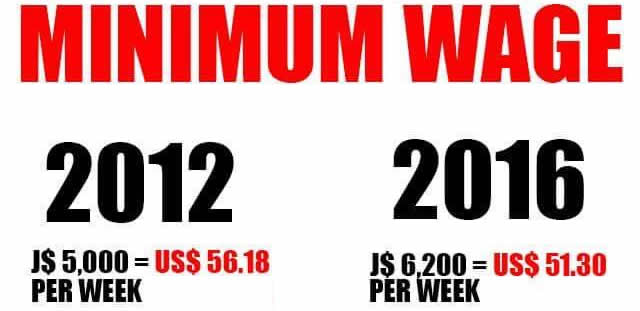
A former student of the London School of Economics (LSE) Joe Issa supports a proposal by the Planning Institute of Jamaica (PIOJ), recommending a seven percent increase in the national minimum wage (NMW).

minimum wage 1

“I think it is essential for workers to be paid a fair minimum wage for a fair day’s work, as a safety net to prevent their exploitation.

“I also believe that in addition to being paid a fair minimum wage, they must be paid a decent salary, one that will meet their basic household needs such as food and shelter and allow them to live in dignity.


Joey 5
Joseph “Joey” Issa


“Having determined what that fair and decent minimum wage should be, to prevent exploitation and allow for a decent living, it must then be protected from the ravages of inflation, so that their purchasing power and living standard is maintained over time.

“And even as I urge employers to pay more depending on the economic value of particular labour, I am mindful of the importance of not pressuring those who themselves are workers on a fixed income and without the benefit of yearly increases.

“Therefore, I support the recommendation by the PIOJ, of a seven percent increase in the current minimum wage,” said Issa, founder of the Cool Group of companies, in an interview.

According to a Jamaica Observer article, the PIOJ recently proposed a seven percent increase in the NMW to the Advisory Commission at its final consultations on a new NMW at the Ministry of Labour and Social Security (MLSS). This increase would move payment for a 40-hour work-week by approximately $434.

It quoted manager of PIOJ’s Human and Community Development Unit Steven Kerr, telling the Commission that “this would meet the NMW’s target of increasing the purchasing power of exceptionally low-income workers, allow for a reasonable degree of security and enable him/her to live with some amount of dignity”.

“The PIOJ’s position was not far off from that of several other contributors to the consultations, who felt that employers of household workers, for example, should be protected from a much higher increase for their employees considering that their salaries were subject to restraint, and suggested a new NMW of $7,500 per 40-hour week.

“Others, including the Tambourine Army and We Change Jamaica, recommended new calculations, including a guaranteed minimum income, as well as segregated NMW increases for industrial and commercial workers, security guards and household workers.

The major trade unions present – the Bustamante Industrial Trade Union (BITU) and the Union of Clerical, Administrative and Supervisory Employees – focused mainly on the wages of private security guards, calling for the reintroduction of a tripartite joint industrial council made up of representatives of the trade unions, the security companies and the MLSS.

“Head of the security guards’ employers, the Jamaica Society for Industrial Security, Commander George Overton, suggested a six percent across-the-board increase. However, he rejected proposals for improvements in insurance coverage.

“But the contribution from the PIOJ, which has always been the most influential on minimum wage commissioners, ranked as the most explosive at the sitting,” the paper reported.